The 1886 Revelation · Historical sourcebook
The manuscript & its meaning
Examine the two written pages, compare the copies, and follow a close reading of Taylor’s words.
In this chapter
The manuscript in Taylor’s hand
Read the historical photograph from left to right. The archival scans and their web transcription are linked under S01; the official collection record is S55.
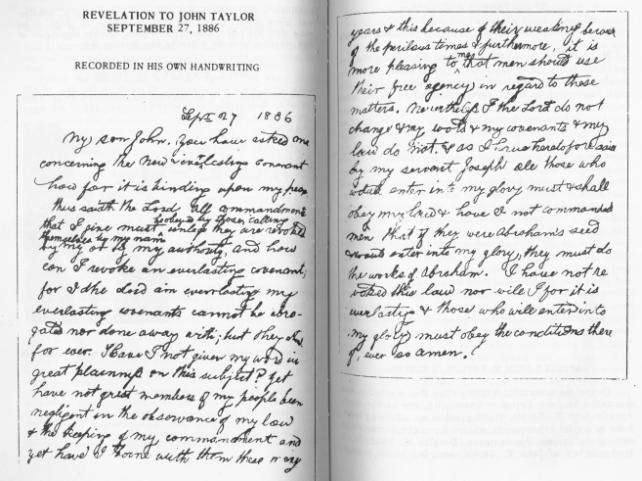
The date and the object
September 27, 1886 is written at the head of the first page. The sheets are in pencil, with text added between lines. A separate ink date, July 25, 1887, is on the reverse. J. Reuben Clark’s July 1933 memorandum says Heber J. Grant added that date on July 17, 1933 to identify the day Taylor died. It is neither a second date of revelation nor Taylor’s signature. The photo shown here preserves the complete two written faces; inspect the archive for the physical sequence.
A reading that changes between copies
On the second written leaf, line 3, Taylor writes “more pleasing” and inserts “me” above the line after “to.” The 1909 copy reads “more”; John T. Clark’s printed p. 125 reads “now,” as does the version in the later reprint of the 1911 proceedings. The October 1938 publication reads “more.” The change is small but consequential: “now” can suggest a newly announced policy about agency. When quoting this clause, identify the edition and retain its reading.
What the document actually says
A close reading in sequence. The following is a paraphrase. For Taylor’s exact order, spelling, and insertions, follow the manuscript link.
The question, the rule, and the concession
Taylor begins with the extent of an existing covenant, rather than a request to create a new organization. The response requires obedience to divine commands until revoked by divine authority and then asks how an everlasting covenant could be revoked. It acknowledges that many have failed to keep the law, that the Lord has borne with them in dangerous times, and that people should exercise agency. The concession is qualified by a renewed assertion of permanence. Reading only the opening or only the agency clause removes a difficulty that the author deliberately leaves in view.
Abraham, glory, and a consequential silence
The closing argument appeals to earlier words through Joseph. It connects entry into divine glory with obedience and with doing what Abraham did, and says the law has not been and will not be revoked. It does not state how many spouses a believer must marry, direct a particular marriage, name a successor, or identify who may solemnize one. Section 132 supplies both an Abrahamic precedent for plurality and rules about sealing authority. Thus plural marriage is a well-supported historical referent, while a perpetual commission outside Church leadership is a separate claim requiring separate evidence.