September 27, 1886 · John Taylor
The 1886
Revelation.
A short document.
A lasting question of authority.
John Taylor, plural marriage, and the historical record. Explore what the manuscript says, how its readers understood it, and why its meaning remains contested.
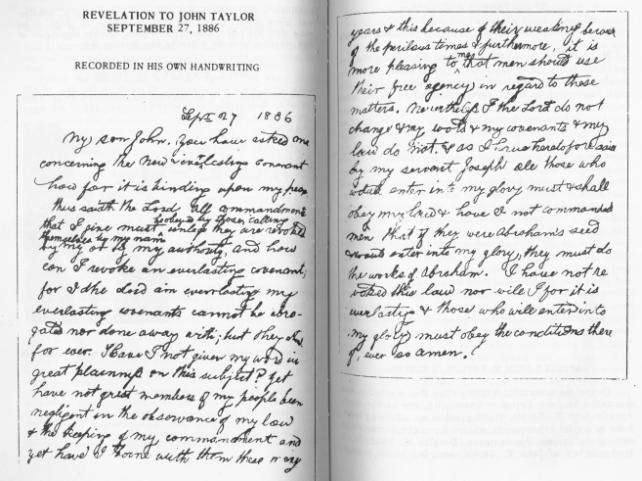
Historical reproduction · Wikimedia Commons
Start with the evidence
One manuscript.
Distinct historical questions.
The document, its early readers, later accounts of appointments, and the Church’s response each leave a different kind of record.
Why the interpretations divergeWhat survives
On September 27, 1886, John Taylor, the third president of The Church of Jesus Christ of Latter-day Saints, put a question and an answer on paper. The question concerned how far the new and everlasting covenant bound his people. The answer, written in the Lord’s voice, affirmed the covenant’s permanence. The Church History Library now catalogs the two handwritten sheets under Taylor’s name, MS 34928. The document, a dated 1909 copy, and a 1933 memorandum of receipt give the inquiry a firmer starting point than later arguments about what happened that day.
What his contemporaries understood
Taylor’s wording invokes Joseph and Abraham without naming plural marriage. It would nevertheless be misleading to tell a reader that the polygamy interpretation arose only in the twentieth century. Heber J. Grant’s 1890 journal and Abraham H. Cannon’s 1892 journal independently record John W. Taylor connecting a revelation given to his father with plural marriage. These are two records of the son’s interpretation. Neither diarist says he watched the father receive the revelation or saw him appoint a successor.
Where the historical question changes
The manuscript gives no one an office, names no new council, and describes no visitation. Lorin C. Woolley later described events at his father’s home, including an extraordinary experience and, in a more detailed account, appointments. These claims matter because believers invoked them to explain who could authorize plural marriages after the Church stopped authorizing the practice. A historian can trace when the accounts circulated, which witnesses depended on one another, and where they differ. A manuscript cannot authenticate an event it does not describe.
What the Church recognizes
Archival attribution and ecclesiastical authority answer different questions. In a 2025 statement the Church called the manuscript Taylor’s private writing and said it had never treated it as authoritative. Its historical essay acknowledges that some new plural marriages continued after the 1890 Manifesto. Its current teaching rejects plural marriage as a requirement for exaltation and prohibits its practice. All three points belong alongside the manuscript and the fundamentalist reading. The source IDs below link to a register with the edition, locator, URL, and what was verified.
Follow the record
Read the sourcebook
Move from the historical setting to the testimony and the arguments built upon it.
The manuscript
Examine the two written pages, compare the copies, and follow a close reading of Taylor’s words.
Read this chapterBefore 1886
Marriage, the works of Abraham, and the authority to seal: the language Taylor inherited and used.
Read this chapterThe Manifestos
Woodruff’s 1889 revelation, the 1890 Manifesto, and the disciplinary declaration of 1904.
Read this chapterThe earliest readers
Family readings, apostolic diaries, and the revelation’s appearance at John W. Taylor’s disciplinary hearing.
Read this chapterThe document’s journey
Follow the manuscript from family papers and early printings to the First Presidency in 1933.
Read this chapterWoolley & the witnesses
Separate the dates of the claimed events from the dates when witnesses recorded their accounts.
Read this chapterReading Ogden Kraut
Four works, their sources, and the distinction between reproduced testimony and theological interpretation.
Read this chapterPublic memory & response
The document’s preservation, changing public descriptions, and the significance of its digital release.
Read this chapterWhy readings differ
A continuing covenant, competing claims of authority, and the limits of the surviving evidence.
Read this chapterFour historical questions
Canonization, contemporary diaries, the reach of the Manifesto, and the survival of existing families.
Read this chapterKeep the sources close
Read, compare,
and check the record.
Follow each source label to the edition, page reference, research note, and original link. The complete sourcebook is also available as a PDF.